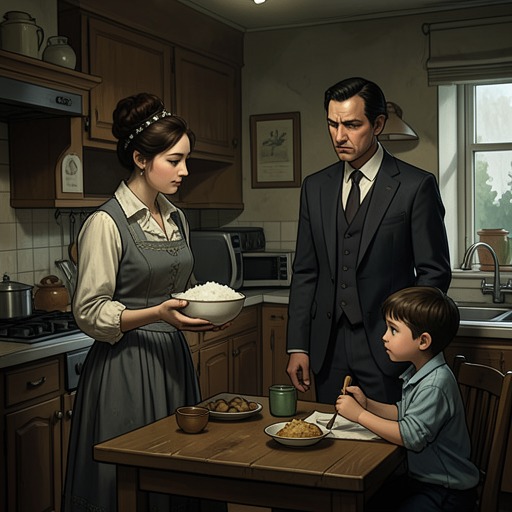
The Su family’s financial crisis and revival
CEO's Beloved Honey GirlThe Su family’s financial crisis and revival forms one of the book’s central economic and relational pressures: the family’s diminished strength leaves it vulnerable to outside control, yet its remaining talent and opportunities make recovery possible. The crisis is never treated as a purely commercial problem. Land bids, corporate projects, family alliances, and private favors repeatedly determine whether the Su Family will remain marginal or regain influence.
A Family Capital Base Under Strain
The Su Family’s weakened position is made explicit when Su Xiangcheng discusses the western-district land scheduled for bidding the following month. She explains that the company will have difficulty competing for it and asks Bian Jiang to approach Lu Xun about whether he might be interested. The request reveals a business organization unable to secure an important opportunity on its own and compelled to seek access through Lu Xun’s power. Bian Jiang’s assistance has already improved the company’s performance, but the improvement has not restored the organization to its former condition. The Su Family is functioning, yet its recovery remains incomplete and precarious.
That dependence gives every business proposal a second meaning. A land bid is simultaneously a test of corporate capacity and a possible route into Lu Xun’s sphere of influence. Su Xiangcheng’s fear that she is about to be abandoned turns the family’s financial uncertainty into a personal crisis: the company’s survival appears tied to whether powerful allies still consider the family worth supporting. The commercial weakness therefore produces emotional vulnerability as well as material risk.
Projects as Instruments of Revival
The possibility of revival becomes clearer when Lu Xun argues that a project given to the Su Clan could enable it to make a successful turnaround. Song Yun’er initially doubts that the Su Clan has enough strength to handle the project, but Lu Xun rejects that judgment. He specifically identifies Bian Jiang’s abilities as substantial, suggesting that the family’s problem is not an absolute lack of competence. Rather, Bian Jiang lacks the authority to make his abilities count within the existing power structure.
Lu Xun even offers to hand the project to the Su Clan immediately, warning that Song Yun’er may regret refusing the opportunity later. Her eventual decision to take on the project transforms the family’s prospects from passive decline into an active test of execution. The proposed revival thus depends on a combination of dormant internal ability and externally controlled opportunity. The Su Family can recover, but its recovery is mediated by people who possess the authority to allocate projects, land, and institutional access.
The same logic appears in the eastern-district land dispute. Lu Xun tells Lin Yanche that his condition is that Lin must never interfere in his affairs with Su Qingrou. He then accepts the land, plainly stating that he was not interested in it at the beginning. The transaction is therefore not driven by ordinary commercial desire. Lu Xun uses a valuable corporate asset as leverage to force Lin Yanche to sever his interference, while Su Xiangcheng realizes that the sacrifice is being made for her sake. The Su–Lin conflict and the Su Family’s economic position become entangled: land is not merely property but a bargaining instrument in a struggle over relationships.
Family Relations Inside the Economic Crisis
The family’s financial condition is intensified by the instability of its members. Su Qingrou’s distress is connected to Lin Yanche’s imprisonment and mistreatment of her, and Su Xiangcheng’s reaction to the marks on her sister’s body makes the family’s vulnerability bodily and immediate rather than abstract. The photograph showing Lin Yanche embracing Song Yun’er adds another layer of betrayal to the situation. Under such circumstances, the Su Family’s choices cannot be separated from attempts to protect its members from men whose personal power exceeds the family’s ability to resist.
Su Qingrou later proposes a small engagement ceremony with Jin Zhengnan, primarily for the benefit of their two companies. The plan demonstrates how family and corporate strategy can be joined deliberately: an engagement is not presented only as a romantic commitment but also as a stabilizing alliance between business interests. Su Xiangcheng worries that Lin Yanche may react, while Su Qingrou answers that the family has a brother who can provide protection. The proposed ceremony consequently functions as both a public economic arrangement and a defensive response to private danger.
The relationship between family welfare and personal sacrifice also appears in Lu Xun’s dealings with Lin Yanche. Lu Xun’s willingness to exchange the eastern-district land for non-interference protects Su Qingrou and Su Xiangcheng’s interests, but it also shows how easily the Su Family’s commercial resources can be absorbed into another person’s strategy. The family’s revival is therefore accompanied by a question of sovereignty: whether recovery through powerful allies will restore independence or deepen dependence.
Institutional Exclusion and Unequal Access
Qin Mo’s wedding gift to Qin Mo and Su Qingrou exposes the wider institutional barriers surrounding the family’s social and commercial environment. Qin Mo has two Maserati keys for the couple, but explains that he could not enter the relevant hospital to pass the gift through the intended channel. Since the previous incident, Imperial Conglomerate has blacklisted him; its hotels, hospitals, and entertainment venues refuse to receive him. The blacklist illustrates how access to a corporate empire can become a form of punishment, and it helps explain why family relationships and business relationships operate under such pressure.
For the Su Family, the existence of this blacklist signals the power imbalance between a vulnerable family enterprise and a conglomerate capable of controlling multiple public-facing institutions. The family’s prospects are shaped not only by whether it can produce value but by whether larger organizations permit its members and associates to enter their spaces, receive their projects, and use their infrastructure. Economic revival consequently requires navigation of informal sanctions as well as formal competition.
Recovery, Risk, and Narrative Significance
The evidence presents the Su Family’s revival as possible but conditional. Bian Jiang’s improved performance supplies an internal basis for recovery; the western-district bidding opportunity offers a concrete challenge; Lu Xun’s proposed project provides a route toward a turnaround; and the engagement plan involving Jin Zhengnan supplies a possible alliance. Yet each opening is attached to another person’s power, another family’s hostility, or another emotional debt.
The family’s financial crisis thus acts as the material structure beneath the novel’s intimate conflicts. Lu Xun can redirect land, projects, and protection according to personal commitments. Lin Yanche can use commercial cooperation to approach Su Qingrou. The Su Family can seek recovery through capable managers and alliances, but it cannot easily separate corporate decisions from the threats surrounding its daughters. Even Lu Xun’s eventual arrival at the villa with Chu Fei and the emaciated, unkempt Lin Yanche underscores how business power, violent conflict, and family consequence converge in the same network.
What emerges is not a simple fall followed by a complete restoration. The Su Family survives through repeated negotiations in which competence must be recognized, opportunities must be transferred, and private relationships must be converted into economic protection. Its revival remains a contested process: a movement toward renewed strength that also records the cost of needing powerful outsiders to make that strength visible.